
Custom embroidered jackets are one of the most practical ways to give employees, teams and organizations a professional branded layer for cooler weather.
But once you decide you want jackets, another question usually comes up:
Should you choose fleece or softshell?
Both can work very well for embroidery.
The better choice depends on where your team will wear the jackets, how much warmth they need, how often they work outdoors and whether wind or light rain protection matters.
At MRAYLA Embroidery and Stitches in London, Ontario, we look at the garment and the embroidery together. A jacket that works perfectly for an indoor office team may not be the best option for a landscaping crew, delivery team or outdoor event staff.
This guide compares fleece and softshell jackets so you can choose the right option before adding your logo.
Fleece vs Softshell Jackets at a Glance
| Feature | Fleece Jacket | Softshell Jacket |
|---|---|---|
| Warmth | Very good for its weight | Light to moderate, depending on construction |
| Wind resistance | Limited on most fleece | Usually better |
| Light rain protection | Limited | Usually better |
| Breathability | Very good | Good |
| Softness | Excellent | Smooth and structured |
| Professional appearance | Casual to professional | More polished/corporate |
| Layering | Excellent mid-layer | Strong outer layer |
| Embroidery suitability | Very good | Very good |
| Fine embroidery detail | Can soften on high-pile fleece | Usually cleaner on smooth face |
| Typical cost | Often lower | Often higher |
| Best for | Indoor staff, layering, schools, healthcare | Outdoor crews, service teams, corporate staff, trades |
These are general differences. The exact performance depends on the jacket’s fabric weight, construction, lining and manufacturer specifications.
What Is a Fleece Jacket?
Fleece is generally a soft knitted material made from polyester or recycled polyester.
Its biggest advantage is warmth without excessive weight.
The fabric traps air within its structure, which helps insulate the wearer while still allowing heat and moisture to escape.
That makes fleece particularly useful for:
- Office staff
- Healthcare teams
- Schools
- Coaches
- Warehouse employees
- Restaurant staff
- Indoor service teams
- Employees moving between indoor and outdoor areas
- Layering underneath a winter coat
Fleece is generally breathable and quick drying, but ordinary fleece should not be treated as a waterproof jacket.
It also normally provides less wind protection than a softshell.
Think of fleece primarily as:
a comfortable insulating layer.
What Is a Softshell Jacket?
A softshell is designed more like an outer layer.
Softshell fabrics are typically smooth on the outside and often contain stretch so the garment moves comfortably with the wearer.
Depending on the particular jacket, a softshell may provide:
- Wind resistance
- Light rain resistance
- Stretch
- Breathability
- Abrasion resistance
- Light insulation
Softshells are generally intended for variable conditions rather than prolonged heavy rain.
They are particularly useful for:
- Construction and trades
- Property-service crews
- Sales teams
- Delivery employees
- Outdoor event staff
- Automotive businesses
- Landscaping crews
- Corporate teams
- Customer-facing field staff
Because of their cleaner exterior and structured appearance, softshell jackets often look more like professional uniform outerwear than traditional fleece.
Which Is Warmer: Fleece or Softshell?
This is where the comparison becomes more complicated than simply saying one is warmer.
Fleece focuses on insulation.
The loft of fleece traps air and helps retain body heat.
A midweight or heavyweight fleece can therefore feel quite warm, especially when there isn’t much wind.
Softshell focuses more on protection.
A softshell usually blocks wind better.
That can make it feel warmer outdoors even when the actual insulating layer isn’t as thick as a fleece.
For example:
A fleece might feel warmer inside a cool warehouse.
The softshell may feel more comfortable outside in cold wind.
For very cold weather
Neither garment should automatically be treated as a complete Canadian winter jacket.
A practical layering system may be:
Base layer → fleece → outer shell
or an insulated winter jacket may be required.
For team uniforms, choose based on where the employee spends most of the working day.
Which Is Better in Wind?
Softshell generally wins.
Standard fleece is breathable partly because air can move through its structure.
That is excellent when someone is active or working indoors.
It is less helpful when standing outside in a strong wind.
Softshell fabric typically has a tighter exterior construction designed to provide better wind resistance.
For employees who regularly work:
- Outside
- In parking lots
- At job sites
- Around vehicles
- At outdoor events
- Moving between buildings
softshell is generally the stronger all-around choice.
Which Is Better in Rain?
Again, softshell generally has the advantage—but there is an important distinction.
Water-resistant is not the same as waterproof.
Many softshell jackets can handle:
- Mist
- Light rain
- Light snow
- Short exposure to wet weather
They are not necessarily designed for hours of heavy rainfall.
Fleece can continue insulating reasonably well in damp conditions and tends to dry relatively quickly, but ordinary fleece does not provide meaningful rain protection.
If your employees require genuine waterproof protection, you may need a dedicated rain shell rather than either of these garments.
Which Is Better for Embroidery?
The good news:
Both fleece and softshell can work very well for custom embroidery.
But they behave differently under the embroidery machine.
Embroidery on Fleece
Fleece has a textured surface.
Depending on the fleece, the fibres may be:
- Short and tightly cropped
- Soft and brushed
- Thick and fluffy
- High pile
The deeper the pile, the easier it is for small embroidery stitches to visually sink into the fabric.
That doesn’t mean fleece is poor for embroidery.
It simply means the embroidery setup has to account for the texture.
Good fleece embroidery usually benefits from:
- Appropriate backing
- Suitable stitch density
- Adequate underlay
- Clear lettering
- Proper logo sizing
- Water-soluble topping when appropriate for higher-pile fleece
A topping can temporarily hold the surface fibres down so the embroidery sits above them instead of becoming buried in the pile.
Logo design matters
A bold 3.5-inch company logo may look excellent on fleece.
A very delicate logo containing extremely fine lettering may need to be:
- Enlarged
- Simplified
- Digitized differently
The garment and artwork should be evaluated together.
Embroidery on Softshell
Softshell generally has a smoother surface.
That can make it particularly good for:
- Business logos
- Small lettering
- Employee names
- Department names
- Clean corporate branding
The smooth exterior allows embroidery edges and lettering to appear clearly.
However, many softshell fabrics also stretch.
That means the garment still requires appropriate stabilization and hooping so the material does not move or distort during embroidery.
The goal is:
stable embroidery without unnecessarily restricting the garment’s natural flexibility.
Does Embroidery Affect Softshell Water Resistance?
This is worth discussing before ordering.
Embroidery works by repeatedly passing a needle through the fabric.
If a particular jacket relies on a membrane or specialized construction for weather protection, embroidery creates needle penetrations in the decorated area.
For an ordinary water-resistant team softshell, this may not be a significant concern.
But if maintaining a specific waterproof rating is essential to the garment’s job, the decoration method should be confirmed before embroidery begins.
This is especially important for:
- Waterproof shells
- Technical rain jackets
- Safety outerwear
- Specialized outdoor garments
Softshell and fully waterproof rainwear should not automatically be treated as the same product category.
Which Jacket Makes a Logo Look Better?
Both can look professional.
But the appearance is different.
Fleece
Embroidery tends to look:
- Warm
- Comfortable
- Casual
- Approachable
It works particularly well for:
- Schools
- Clubs
- Healthcare teams
- Office staff
- Volunteers
- Coaches
- Community organizations
Softshell
Embroidery tends to look:
- Clean
- Structured
- Professional
- Corporate
It works particularly well for:
- Service businesses
- Construction companies
- Sales teams
- Trades
- Property management
- Corporate employees
- Field staff
If your employees are regularly meeting customers, a softshell often creates the more polished uniform appearance.
Which Is More Comfortable?
That depends on the working environment.
Fleece is usually softer and cozier.
It is particularly comfortable when employees spend long periods:
- Indoors
- Sitting
- Driving
- Working in cool buildings
Softshell provides more protection but often feels more like outerwear.
Its stretch can make it excellent for employees who move frequently.
For physically active teams, also consider breathability.
A very warm fleece may become uncomfortable for employees performing high-output work.
Likewise, an overly heavy jacket isn’t useful if employees immediately remove it once they start moving.
Which Is Better for Construction and Trades?
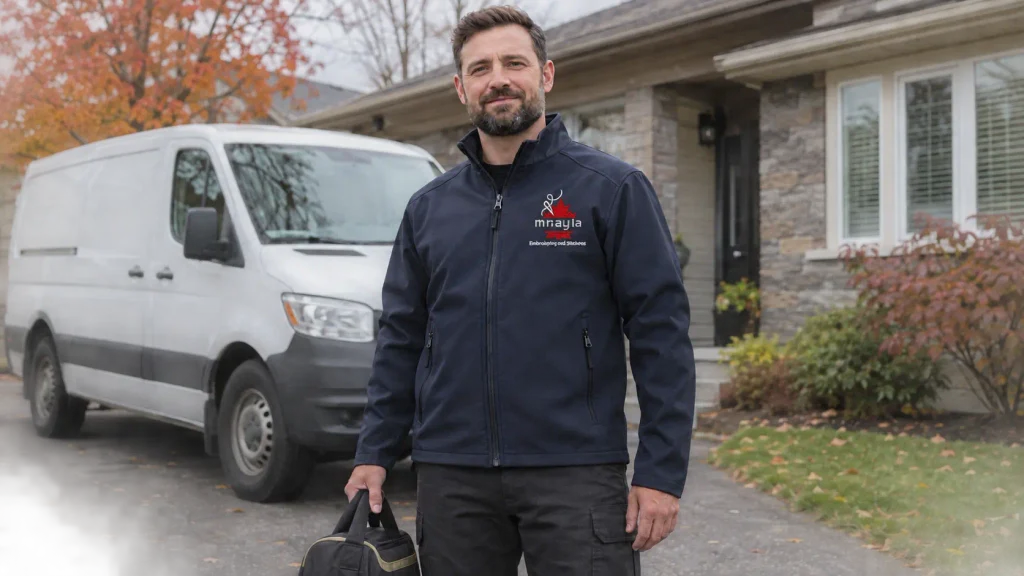
For many construction and trade businesses, I would usually start by looking at softshell.
Why?
Workers frequently move:
indoors → outdoors → vehicle → job site → customer location
Softshell handles that transition well.
It also provides:
- Wind resistance
- Some light-weather protection
- Mobility
- A professional appearance
Examples include:
- HVAC technicians
- Electricians
- Plumbers
- Contractors
- Property-maintenance crews
- Automotive staff
- Service technicians
Fleece can still be excellent as a secondary insulating layer.
In fact, a two-layer uniform program can work very well:
Fleece for warmth + softshell for outdoor protection.
Which Is Better for Office and Corporate Teams?
This one depends on the look you want.
Choose fleece if:
- Comfort is the priority
- Employees mainly work indoors
- You want an easy layering garment
- The environment is casual
- Budget matters
Choose softshell if:
- Employees meet customers
- The jacket is part of a formal uniform
- Staff frequently travel between locations
- You want more structure
- Employees spend time outside
For sales staff and customer-facing employees, softshell often gives the more polished presentation.
Which Is Better for Schools and Sports Teams?
Fleece works particularly well for:
- Coaches
- Teachers
- Volunteers
- School staff
- Clubs
- Supporters
It is warm, comfortable and easy to layer.
Softshell may be better for:
- Outdoor coaches
- Team managers
- Tournament staff
- Athletic departments
- Volunteers working outside
- Staff travelling between venues
Schools and organizations can also use both while keeping the branding consistent.
For example:
Fleece: staff and coaches
Softshell: outdoor coaching and event staff
Use the same logo position and thread colours across both garments for a coordinated appearance.
Which Jacket Is Better for Healthcare Teams?

Fleece can be particularly practical for healthcare and clinic environments where staff want a warmer layer without wearing a heavy outdoor jacket.
Possible uses include:
- Clinics
- Dental offices
- Physiotherapy
- Chiropractic offices
- Administrative teams
- Long-term-care staff
- Wellness businesses
A lightweight or midweight fleece with a small embroidered chest logo can provide professional branding while remaining comfortable indoors.
Softshell makes more sense for employees who travel between facilities or regularly work outside.
Fleece vs Softshell: Which Costs More?
Softshell jackets are often more expensive than basic fleece jackets, but there is no universal price difference.
Cost depends on:
- Brand
- Fabric weight
- Construction
- Lining
- Zippers
- Pockets
- Waterproof or water-resistant features
- Size range
- Quantity
- Garment availability
Embroidery pricing can also depend on:
- Logo size
- Stitch count
- Number of placements
- Personalization
- Digitizing requirements
For a large team, the cheapest jacket is not automatically the best value.
Consider:
How often will employees actually wear it?
A slightly more expensive softshell worn three seasons of the year could be a better investment than a cheaper garment that stays in the closet.
Likewise, there is no reason to pay for weather-resistant softshell features when the entire team works indoors.
What Is the Best Embroidery Placement on a Jacket?
For most team jackets, the first placement I recommend considering is:
Left Chest
A left-chest logo usually provides the cleanest professional appearance.
A practical starting width for many business logos is roughly 3–4 inches, although the actual logo proportions and jacket construction determine the final size.
Other placements can include:
Right Chest
Useful for:
- Employee name
- Job title
- Department
Sleeve
Useful for:
- Secondary logo
- Sponsor
- Canadian flag
- Department mark
Back
Useful for:
- Larger company branding
- Crew identification
- Event staff
- Service businesses
Before choosing a back design, remember that jackets can contain:
- Seams
- Vent panels
- Linings
- Yokes
- Hoods
These can influence the usable embroidery area.
Can Employee Names Be Added?
Yes.
A common uniform setup is:
Left chest: company logo
Right chest: employee name or role
Examples:
MARVIN
Owner
or:
JESSICA
Site Supervisor
This creates a professional personalized uniform while keeping the company branding consistent.
Can the Same Embroidery File Be Used on Fleece and Softshell?
Sometimes.
If the logo is being embroidered at approximately the same size and placement, the underlying artwork may be reusable.
But the production setup may still need adjustment.
Fleece and softshell behave differently.
The embroidery provider may adjust factors such as:
- Stabilizer
- Topping
- Hooping
- Machine settings
- Stitch density
- Underlay
That is why an embroidery file should not be treated separately from the garment it is going onto.
What Logo Designs Work Best on Jackets?
Jackets generally provide a good embroidery surface, but the same design principles still apply.
Embroidery works best when the logo contains:
- Clear lettering
- Strong shapes
- Adequate spacing
- Appropriate line thickness
- Good contrast
Potential issues include:
- Extremely tiny taglines
- Very thin lines
- Excessive detail
- Large dense filled areas
- Small negative spaces
If necessary, a logo can be adapted into a simplified embroidery version while still preserving the brand identity.
How Should Embroidered Jackets Be Washed?
Always follow the garment manufacturer’s care label first.
That is especially important with softshells because some use:
- Laminated fabrics
- Durable water-repellent treatments
- Bonded layers
- Specialized finishes
General good practices for embroidered jackets include:
- Use an appropriate mild detergent
- Avoid unnecessary high heat
- Close zippers before washing when recommended
- Avoid aggressive abrasion against the embroidered area
- Don’t pull loose embroidery threads
- Follow the garment’s drying instructions
Fleece may also develop surface pilling over time, particularly in high-friction areas.
Proper care helps both the jacket and embroidery continue looking professional.
Should Your Team Choose Fleece or Softshell?
Here’s the simplest way I would decide.
Choose fleece when:
- Warmth is the main priority
- Staff mainly work indoors
- You want a comfortable mid-layer
- The team needs something soft
- Budget is important
- Employees will wear another outer shell in bad weather
Choose softshell when:
- Employees work outdoors
- Wind protection matters
- Light rain resistance is useful
- Customer-facing appearance matters
- Employees move between indoor and outdoor environments
- You want one versatile branded jacket
Choose both when:
Your team has mixed working conditions.
A fleece and softshell program can provide:
Fleece → warmth
Softshell → weather protection
Use the same embroidery logo and placement across both to maintain a consistent uniform.
Frequently Asked Questions
Are fleece jackets good for embroidery?
Yes. Fleece can produce excellent embroidery when the design, stabilizer and production setup account for the fabric’s texture. Higher-pile fleece may require topping to help prevent small stitches from sinking into the surface.
Are softshell jackets good for embroidery?
Yes. Softshell jackets generally provide a smooth embroidery surface and can produce crisp professional logos. Their stretch and construction still need appropriate stabilization.
Is fleece warmer than softshell?
Fleece generally emphasizes insulation, while softshell emphasizes wind and light-weather protection. A fleece may feel warmer indoors, while a softshell may feel more protective outside in wind.
Is softshell waterproof?
Not necessarily. Many softshell jackets are water-resistant rather than fully waterproof. Check the specifications of the particular garment if rain protection is important.
Which jacket looks more professional?
Softshell usually creates a more structured corporate appearance. Fleece can still look very professional but generally has a softer, more casual feel.
Which is better for construction workers?
Softshell is often the more versatile outer layer because it offers wind protection, mobility and a professional appearance. Fleece can work well as an insulating layer underneath.
Which is better for office staff?
Fleece is often a very practical option for teams that mainly work indoors. Softshell may be better for employees who frequently meet customers or move between locations.
Can we add employee names to the jackets?
Yes. Employee names, job titles or departments can be embroidered separately from the main company logo.
Can the same logo be embroidered on different jacket types?
Usually, yes, although the production setup may need adjustment depending on the fabric, texture and construction of each jacket.
What size should a jacket logo be?
Approximately 3–4 inches wide is a common starting range for many left-chest business logos, but the ideal size depends on the proportions of the artwork and jacket construction.
Choosing the Right Custom Embroidered Jacket
There isn’t one jacket that is automatically best for every team.
The right choice depends on how your employees actually work.
If they need:
Warmth + softness + easy layering → start with fleece.
If they need:
Wind protection + light weather resistance + polished outerwear → start with softshell.
If they work in a mix of conditions, using both may provide the most practical uniform system.
At MRAYLA Embroidery and Stitches in London, Ontario, we help businesses, schools, teams and organizations choose garments that suit both their working environment and their embroidery.
Whether you’re outfitting a small team or placing a larger staff order, we can help you review the jacket style, logo, embroidery placement and quantities before production.
Request a free quote for custom embroidered jackets and tell us how your team plans to use them.